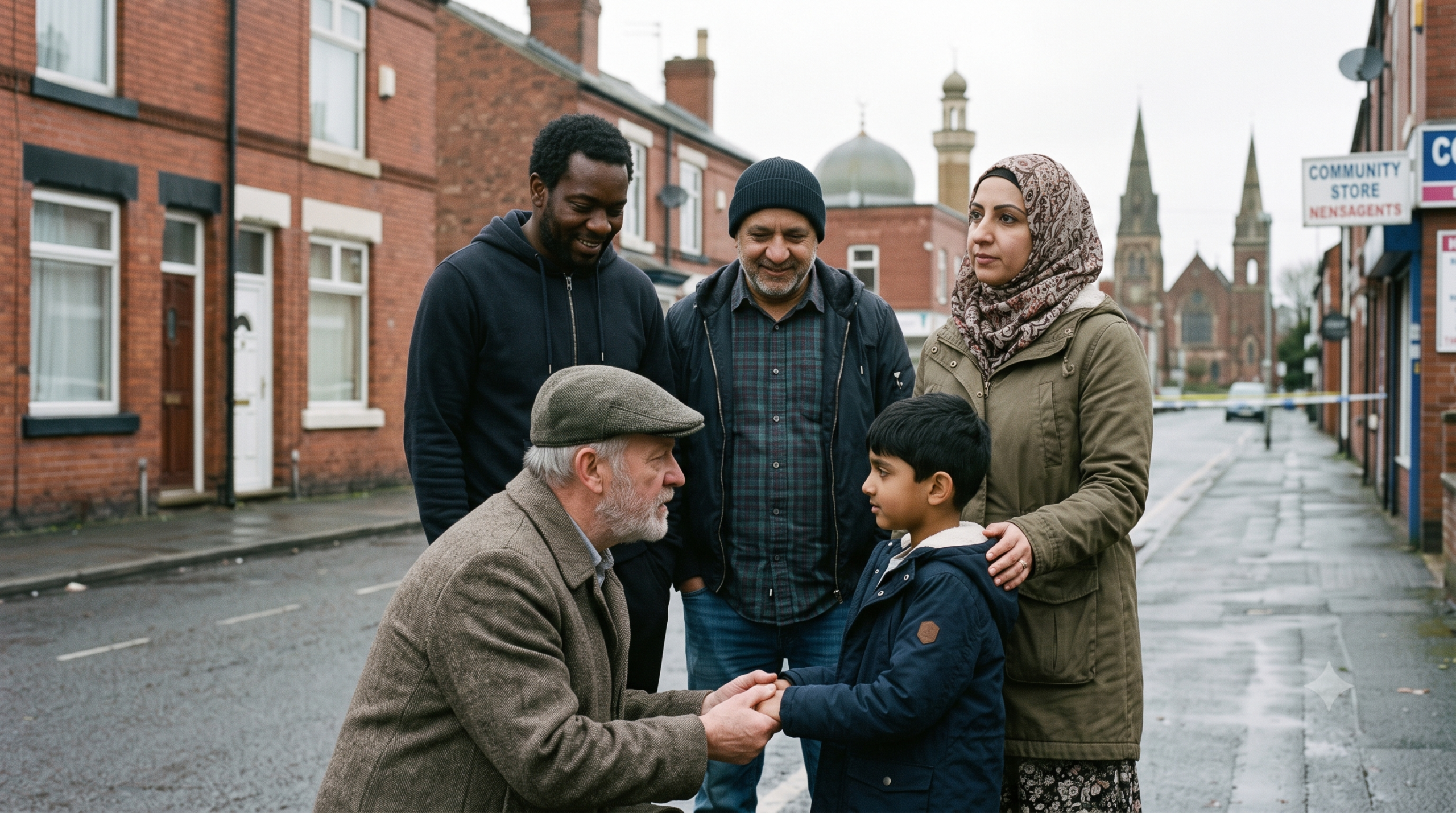
In the wake of recent violent incidents in the UK, Muslims and minority communities have faced unjust blame and threats. This article reflects on collective punishment, Islamophobia, and how our faith calls us to respond with justice and wisdom.
The recent protests following the tragic murder of Henry Nowak and the knife attack in Belfast have once again exposed a troubling reality within our society. While communities have every right to grieve, seek justice and demand answers, anger has too often been directed towards innocent minorities who had no connection whatsoever to these crimes.
In the aftermath of these incidents, Muslims and other minority communities found themselves blamed, threatened and targeted. This occurred despite the fact that those responsible were individuals acting alone and not representatives of any faith or community. Yet businesses were attacked, property was damaged and many ordinary families were left fearing for their safety and security.
Collective blame and the demand for justice
Criminal acts are the responsibility of those who commit them, not of entire communities who share neither their actions nor their motives. Justice requires that guilt be assigned to the guilty alone. When blame is spread across whole communities, innocent people inevitably suffer.
Sadly, such reactions are often fuelled not by facts but by rumours, misinformation and prejudice. History teaches us the dangers of collective suspicion. During the Cold War, McCarthyism created an atmosphere in which entire groups were viewed with distrust and accused of disloyalty. Today, similar attitudes can be seen in the rise of Islamophobia, where Muslims are frequently portrayed as a threat regardless of their actual beliefs, conduct or contributions to society.
The reality of Muslim life in Britain
This narrative becomes even more difficult to justify when one considers the reality of secular modern Britain. Muslims serve at the highest levels of public life, including positions such as the Mayor of London and senior government offices. They are entrepreneurs, doctors, nurses, teachers, journalists, athletes, charity workers and community leaders. Muslim-owned businesses employ thousands of people and contribute significantly to the economy. In every field of British life, Muslims have contributed to strengthening the country they have settled in.
Yet despite these contributions, some continue to view Muslims with suspicion, as though their loyalty to Britain is somehow in question. This perception is not only unfair but deeply harmful. Attitudes rooted in division foster fear where there should be understanding.
A parent’s concern and our faith’s guidance
For Muslim parents, these events naturally raise concerns about the future. We worry about the safety of our children, the security of our families and the kind of society they will inherit. No parent wants their child to grow up feeling unwelcome, judged or fearful because of their faith or background.
Islam teaches us that leadership carries a responsibility to protect and serve the people. The Prophet Muhammad ﷺ said:
“The Imam is but a shield behind whom the people fight and by whom they are protected.”
(Sahih al-Bukhari and Sahih Muslim)
This hadith highlights the importance of the Imam (ruler) whose role is to lead and protect the entirety of their people. It reminds us that those entrusted with authority have a duty to safeguard the lives, property and dignity of all people under their care. When communities feel vulnerable or exposed, it is natural to reflect upon the absence of such leadership, the kind of representation and protection that characterised the times of the Rashidun, Umayyad, Abbasid and Uthmani leaderships.
At the same time, our faith teaches us to respond to injustice with principle, not prejudice; with wisdom, not anger. We must reject attempts to hold entire communities responsible for the actions of individuals, just as we would reject such treatment for ourselves.
The answer to violence is not more division. The answer to fear is not scapegoating. The answer lies in truth, justice and the recognition that our neighbours are not our enemies. As Muslims, we are commanded to uphold justice and good character even in difficult times and to reject prejudice wherever it appears.
Allah ﷻ says:
“Allah does not forbid you from being kind and just towards those who have not fought you because of religion nor driven you out of your homes. Indeed, Allah loves those who act justly.”
(Surah Al-Mumtahanah 60:8)
May Allah protect our families, guide our communities, and grant us the wisdom to respond to difficult times with patience, justice and dignity.
Abu Amara, Your Brother in Islam
Key takeaways
- Blame for criminal acts must rest with those who commit them, not with entire communities who had no involvement.
- Islamophobia and collective suspicion are fuelled by misinformation and prejudice, not by the reality of Muslim life in Britain.
- Muslims contribute to British society at every level in public service, business, healthcare, education and beyond.
- Our faith calls us to respond to injustice with wisdom, principle and justice, not with fear or anger.
- Those in authority carry a duty to protect the dignity and safety of all people under their care.

Related Articles

The greatest gift
LEAVING A CHILD orphaned is one of the great fears that most parents have. It stems from the inherent desire to protect one’s children. Death is a given. But when children are older and standing on their own two feet, we feel that we have fulfilled our responsibility to them and the thought of passing […]

Will there ever be Peace
‘SO WHY CAN’T they all live in peace?’ my daughter asked 2 years ago when the last major eruption of violence occurred in Palestine. As the current horror unfolds, we reminded ourselves of that discussion and our visit to Jerusalem 6 years ago when we witnessed first-hand the daily oppression that the Palestinians face. When […]

Fear and insincerity
PHAROAH HAD FALLEN and Musa (as) led his people across the desert in search of a new beginning. They came to Jerusalem which Allah intended at that time for Bani Isra’il to take back. Musa said: ‘O my people! Enter the Holy Land which Allah has destined for you. And do not turn back or […]